To generate/create Image XML Sitemap in WordPress properly, we need to use an action hook called publish_{$post->post_type} ( triggered whenever a post, page or Custom Post Type(CPT) is updated, or its new status is “publish” ).
Before seeing the complete code, we need to know about XML image sitemap required tags and its definition:
<image:image>(required) => Encloses all information about a single image. Each <url> tag can contian up to 1000 <image:image> tags.
<image:loc>(required) => The URL for the image.
<image:caption>(optional) => The caption of the image.
<image:title>(optional) => The title of the image.
<image:geo_location>(optional) => The geographic location of the image.
<image:license>(optional) => A URL to the license of the image.
I generated an image sitemap using posts, pages and Custom Post Type( CPT ) featured images and the images from the post content. I used a regular expression to get images from post content.
Here is the complete code to create an image XML Sitemap for post, page and Custom Post Type(CPT) in WordPress:
add_action( 'init', 'wpartisan_xml_image_sitemap_initialization' );

function wpartisan_xml_image_sitemap_initialization(){
	global $all_post_type_names;
	$default_posts_types = array(
		'page' => 'page',
		'post' => 'post',
	);
	$args = array(
		'public'   => true,
		'_builtin' => false,
	);
	$custom_post_types = get_post_types( $args, 'names' );
	$all_post_types = array_merge( $default_posts_types, $custom_post_types );
	$all_post_type_names = array_keys( $all_post_types );

	if( !empty( $all_post_type_names ) ) {
		foreach( $all_post_type_names as $post_type_name ):
			add_action( 'publish_'.$post_type_name, 'xml_image_sitemap', 10, 2 );
		endforeach;
	}
}

function xml_image_sitemap( $ID, $post ) {

	global $all_post_type_names;

	$sitemap = '<?xml version="1.0" encoding="UTF-8"?>';
	$sitemap .= '<urlset xmlns="http://www.sitemaps.org/schemas/sitemap/0.9" xmlns:image="http://www.google.com/schemas/sitemap-image/1.1">';

	foreach ( $all_post_type_names as $pty_name ) :

		if( $pty_name === 'page' ):
			$args = array(
				'sort_order' => 'desc',
				'sort_column' => 'post_modified',
				'hierarchical' => 1,
				'exclude' => '',
				'include' => '',
				'meta_key' => '',
				'meta_value' => '',
				'authors' => '',
				'child_of' => 0,
				'parent' => -1,
				'exclude_tree' => '',
				'number' => '',
				'offset' => 0,
				'post_type' => ''.$pty_name.'',
				'post_status' => 'publish'
			);
			$posts = get_pages($args);
		else:
			$args = array(
				'numberposts' => -1,
				'orderby'     => 'modified',
				'order'       => 'DESC',
				'exclude'     => '',
				'post_type'   => ''.$pty_name.'',
			);
			$posts = get_posts($args);
		endif;

		if ( !empty( $posts ) ) {
			foreach( $posts as $post ) {
				setup_postdata($post);
				$page_url = get_permalink( $post->ID );

				$content = $post->post_content;
				$regex = '/src="([^"]*)"/';
				preg_match_all( $regex, $content, $matches );
				$matches = array_reverse($matches);

				if ( has_post_thumbnail( $post->ID ) || !empty( $matches[0] ) ) {

					$img = '';

					if( has_post_thumbnail( $post->ID ) ){

						$title = get_post(get_post_thumbnail_id($post->ID))->post_title;

						$img .= '<image:image>' . "\n";
							$img .= '<image:loc>' . get_the_post_thumbnail_url( $post->ID ) . '</image:loc>' . "\n";
							$img .= '<image:title>' . esc_html( $title ) . '</image:title>' . "\n";
						$img .= '</image:image>' . "\n";

					}

					if( !empty( $matches[0] ) ){
						foreach( $matches[0] as $content_image_url ){
							$img .= '<image:image>' . "\n";
								$img .= '<image:loc>' . $content_image_url . '</image:loc>' . "\n";
							$img .= '</image:image>' . "\n";
						}
					}

					$sitemap .= "<url>\n";
					$sitemap .= "<loc>" . $page_url . "</loc>\n";
					$sitemap .= $img;
					$sitemap .= "</url>\n";

				}

			}
		}
	endforeach;
	$sitemap .= '</urlset>';
	$fp = fopen(ABSPATH . "sitemap-media.xml", 'w');
	fwrite($fp, $sitemap);
	fclose($fp);
}
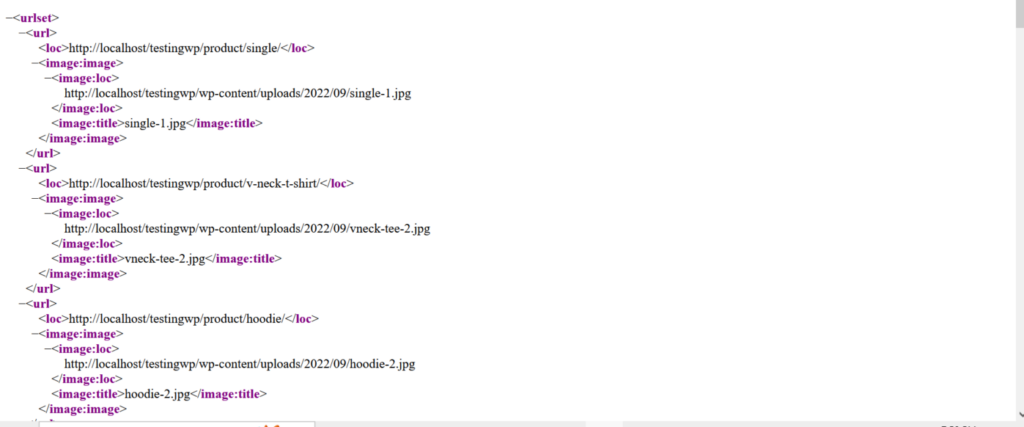
XML Sitemap example image
Plugins to Enhance Your WooCommerce Store
Carefully selected tools to help you customize, manage, and optimize your WooCommerce experience.
Woo Parent Category Selector
- Automatically assign parent categories when child categories are selected
- Prevent accidental removal of required parent categories
- Automatically repairs missing parent category assignments during product save
- Bulk repair existing WooCommerce product category structures
- Keeps product category structures organized and consistent

Product Catalog Mode For WooCommerce
- Turn your WooCommerce store into catalog mode instantly
- Hide Add to Cart buttons and product prices conditionally
- Apply rules by user role, country, or scheduled time periods
- Display custom messages and inquiry options for products
- Control visibility settings globally or per product

Remove Add to Cart Button for WooCommerce
- Remove Add to Cart buttons from shop and product pages
- Hide buttons conditionally for selected products or categories
- Replace Add to Cart with custom text or messages
- Control button visibility by user role and product type
- Lightweight settings interface with easy customization

Remove Product Content for WooCommerce
- Hide product title, image, price, rating, and descriptions
- Remove tabs, meta information, SKU, tags, and related products
- Control visibility separately for shop and single product pages
- Customize WooCommerce layouts without coding
- Enable or disable content elements with simple settings

Really Simple XML and HTML Sitemap
- Generate both XML and HTML sitemaps automatically
- Display sitemaps anywhere using ShortCode support
- Include pages, posts, and custom post types
- Exclude selected pages or posts easily
- Supports WPML and Polylang multilingual plugins